
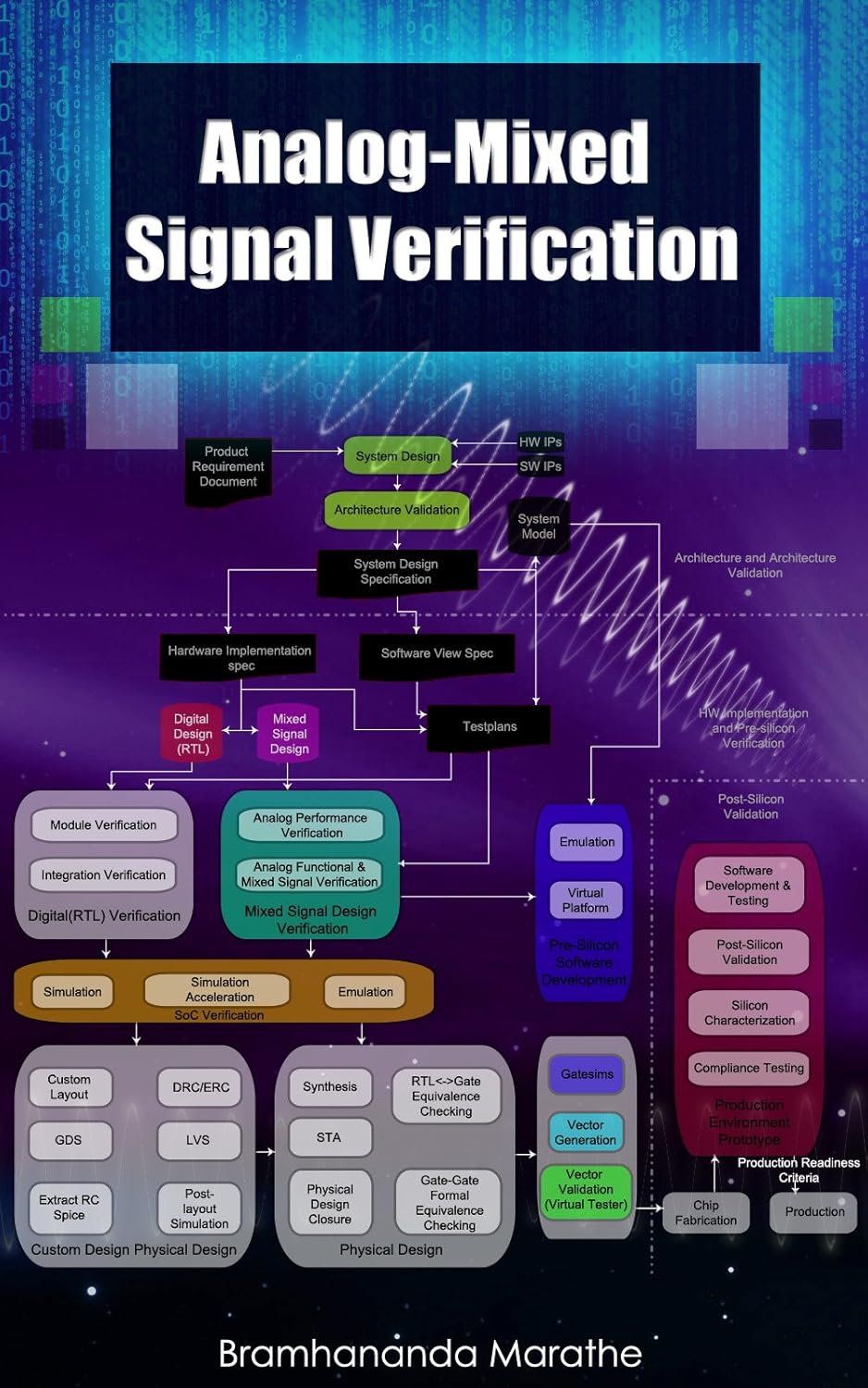
Analog-Mixed Signal Verification
Product details
| Management number | 233619580 | Release Date | 2026/06/27 | List Price | $90.00 | Model Number | 233619580 | ||
|---|---|---|---|---|---|---|---|---|---|
| Category | |||||||||
Introduction The purpose of this book is to provide insight and intuition into the analog and analog-mixed signal system verification. It is also a journey the author of this book has been through on the way to tackle practical design and verification challenges with state of art analog and mixed signal designs. Motivation for authoring this book The digital design verification skill set is very different than analog design and verification. Traditionally, the analog block level verification is performed by the analog designers, and digital design verification is performed by digital design verification engineer. Lack of cross domain skill set makes it challenging to perform verification at mixed-signal level. Hence, either analog designer engineer should learn advanced digital verification techniques or digital design verification engineer embrace analog verification to become analog-mixed signal verification engineer. This book is written keeping this new trend in mind, hence it covers digital design fundamentals, digital design verification as well as analog design fundamentals, and analog performance verification. Organization of this book Keeping the readers of analog verification or digital design verification background in mind, the book has first 5 chapters focused on the fundamentals of the analog design, digital design, and its verification. Chapter 6 and chapter 7 focuses on the analog-mixed signal design verification and behavioral modeling respectively. Chapter 8 is dedicated to the low power verification techniques. Chapter 1: Introduction to Analog Mixed Signal Verification This chapter discusses about the evolution of the verification methodologies, history of analog-mixed signal designs, applications, and future trends. Chapter 2: Analog Design Fundamentals The purpose of this chapter is to give an overview of the analog design fundamentals for digital design background engineers. Major focus is given on analog behavior, design criteria and their concept rather than design themselves, such as voltage/current reference, some of the basic key analog design properties such as gain, band width, basics of jitter, eye diagram, etc. Chapter 3: Digital Design Fundamentals In this chapter, we explain digital design flow, combinational and sequential logic design fundamentals, design for testability, concepts of timing, and timing verification. Chapter 4: Analog Verification This chapter focuses on analog performance verification and functional verification under the context of mixed signal design hierarchical verification rather than the detail performance analysis of the designs themselves. Chapter 5: Digital Design Verification This chapter explains the tools and methodologies that are evolved over the period that are predicated on predictable quality and verification efficiency. The chapter contains the sections on the coverage driven verification (CDV) methodology, assertion based verification (ABV) methodology, and overview of the CDV using Open Verification Methodology (OVM). Chapter 6: Analog-Mixed Signal Verification This chapter discusses about the AMS verification phases, choosing the right abstraction of DUT for a given verification challenge, AMS verification planning, testplanning for AMS design verification, and testbench development with re-use in mind. Chapter 7: Analog Behavioral Modeling This chapter explains about the applications of analog behavioral models, modeling methodology, simple examples of various analog behavioral modeling styles, selection of accuracy level of the models based on the verification plan, model verification, and signoff. Chapter 8: Low Power Verification The purpose of this chapter is to explain the low power design verification challenges, key low power design elements, low power design techniques, low power design and verification cycle, testplanning for low power design verification, power aware digital, and AMS simulations Read more
| ASIN | B017KT3FC8 |
|---|---|
| XRay | Not Enabled |
| Edition | 1st |
| Language | English |
| File size | 7.3 MB |
| Page Flip | Enabled |
| Publisher | Bramhananda Marathe |
| Word Wise | Not Enabled |
| Print length | 322 pages |
| Accessibility | Learn more |
| Screen Reader | Supported |
| Publication date | November 3, 2015 |
| Enhanced typesetting | Enabled |
Bestseller ranking
Circuits


Correction of product information
If you notice any omissions or errors in the product information on this page, please use the correction request form below.
Correction Request Form